Insights
Notes from the coach's desk
Game studies, opening ideas, and engine-explained tactical patterns — written for improving players who want to understand the why, not just memorize the what.
Chess Openings for Beginners: How to Build Your First Solid Repertoire
Stop memorizing endless lines. Learn how to build a compact, rock-solid opening repertoire for White and Black using core chess principles.
Chess Strategy for Club Players: 5 Advanced Positional Concepts to Break Your Plateau
Stuck at a tactical plateau? Discover 5 advanced positional chess concepts—like the Principle of Two Weaknesses, pawn tension, and prophylaxis—to outplay your opponents strategically and raise your Elo.
Chess Strategy for Beginners: The 5 Essential Rules of Positional Play
Tired of aimless piece shuffling? Transition from short-term tactics to long-term planning with these 5 essential rules of positional chess strategy.
What is a Good Accuracy Score in Chess? Rating-Level Benchmarks Explained
Ever wondered what a 'good' accuracy score actually is for your rating? Discover the realistic benchmarks for every level, why the percentage can be misleading, and how to use it to truly improve.
Is 97% Accuracy Good in Chess? What High Accuracy Really Tells You
97% accuracy sounds elite, but the number alone is misleading. Here's what it actually means across opening, middlegame, and endgame — and why some 97% games are stronger than others.
Chess Tactics for Beginners: How to Spot Forks, Pins, Skewers, and Discovered Attacks
Master the four fundamental chess tactics that win games. Learn how to spot forks, pins, skewers, and discovered attacks with concrete examples and board diagrams.
How Many Chess Openings Are There? The Complete Count by ECO Code
A definitive count of chess openings by ECO code (500 main-line codes, A00–E99), with a practical breakdown of which families matter at your rating level and how to build a real repertoire instead of memorizing trivia.
What Is a Good Accuracy Score in Chess? Benchmarks for Every Rating Level
Chess engines score every move from 0-100, but what counts as "good"? Here are the real benchmarks for 800, 1000, 1200, 1500, 1800, and 2000+ rated players — and why a single accuracy number never tells the whole story.
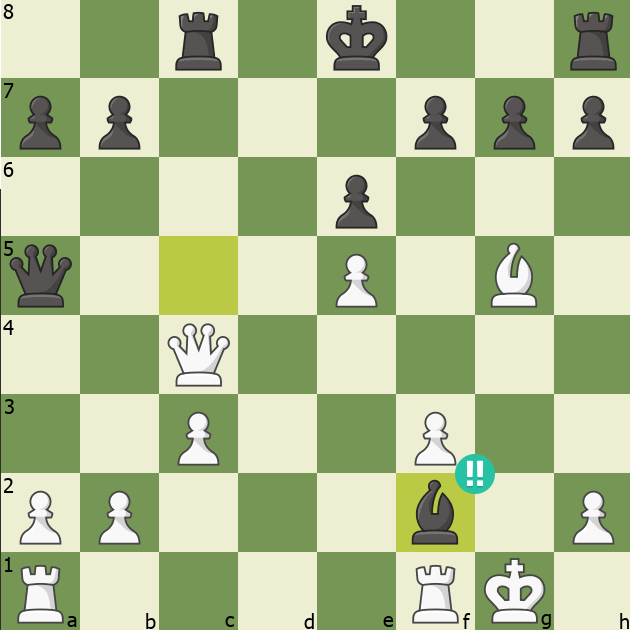
Brilliant Chess Move: Stunning Bishop Sacrifice Led to Checkmate
Most chess players have experienced it at least once. You spot a free pawn, win some material, and feel confident about your position—only to discover that your opponent had seen something much deeper.

Why Your Chess Accuracy Drops After Move 15
If your chess accuracy drops after move 15, the problem is not that you suddenly become a worse player. The problem is that the game has shifted from memory to understanding, and you have not trained that transition enough.

Why You Always Get in Time Trouble (And How Stockfish 18 Fixes It)
Every chess player knows the feeling. You navigate the opening perfectly. You transition into a solid middlegame. You build a completely fine, perhaps even slightly superior, position. And then, you glance at the clock. Your opponent has 15 minutes left. You have 42 seconds. Panic!
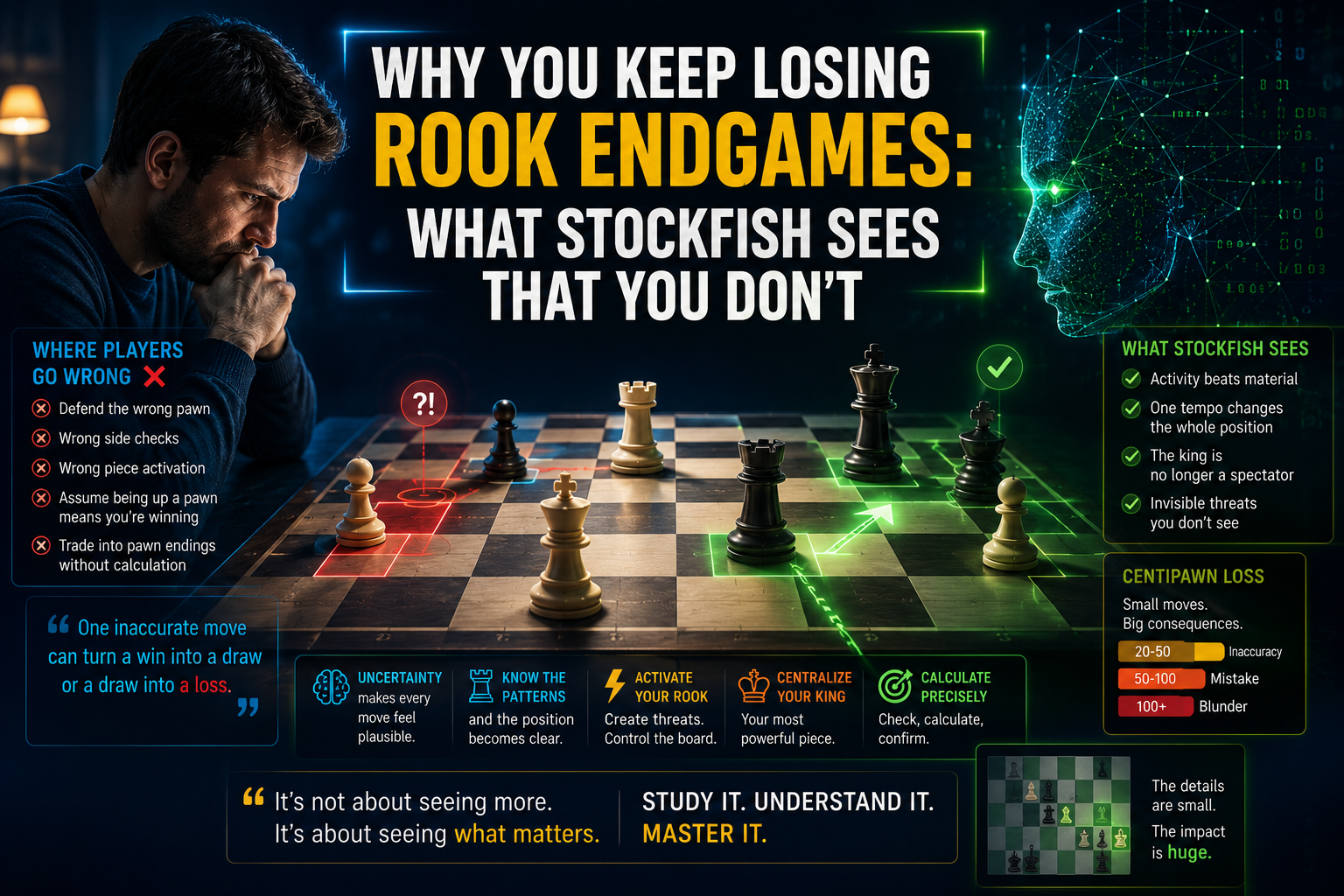
Why You Keep Losing Rook Endgames: What Stockfish Sees That You Don’t
If you keep losing rook endgames, the issue is usually not talent. It is pattern recognition. Once you learn to see what Stockfish sees, your endgames stop feeling random.
Stay in the loop
New posts, straight to your inbox
Once a week, a coach's take on a fresh game or pattern. No spam, no autoresponders — just chess. Unsubscribe with one click.