What Is the Stupidest Rule in Chess?
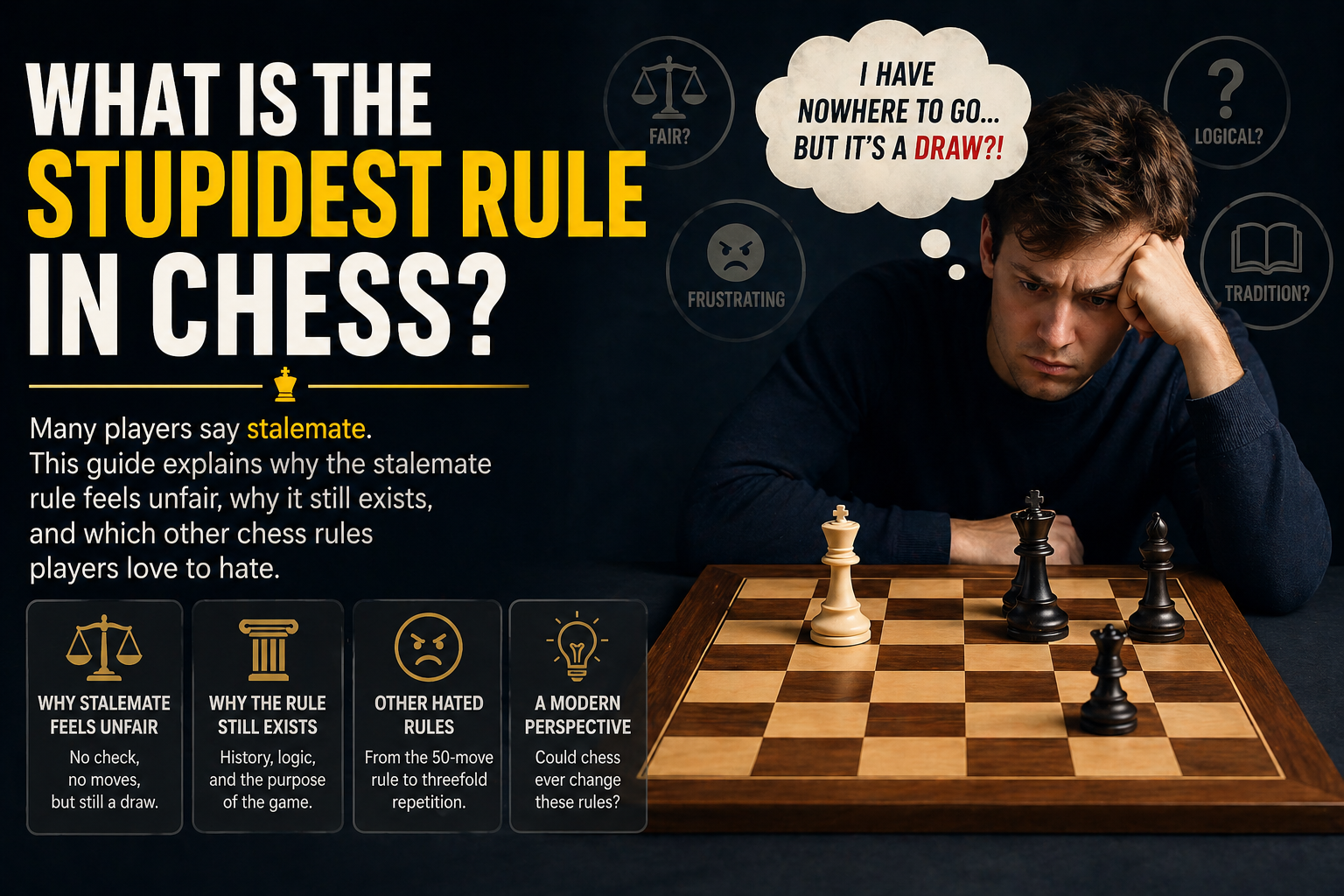
If you ask casual players, beginners, and plenty of frustrated intermediates, the most common answer is simple: stalemate.
It is the chess rule that makes people say, “Wait, how is that not a win?” One side can be completely busted, down a queen, trapped on the edge of the board, and one move away from total humiliation — and yet if that side has no legal move and is not in check, the game is a draw.
To a new player, that feels absurd. It feels like chess suddenly rewards the loser for being helpless. It feels like the game takes a clear victory and turns it into a technicality. And because it arrives in exactly the kind of moments where emotions are already high, stalemate has probably caused more table-slaps, keyboard punches, and stunned silences than any other rule in chess.
But here is the twist that makes this topic interesting: the rule that feels the stupidest is not necessarily a bad rule. In fact, the very thing that makes stalemate so infuriating is also what makes it elegant, educational, and deeply “chess.”
That tension is what this article is really about.
Why this question matters
“What is the stupidest rule in chess?” sounds like a joke question, but it reveals a real divide in how people experience the game.
Beginners often want chess to behave like common sense. If one king is nearly dead, that side should lose. If one player dominates the board, that player should win. If the losing side has no moves, the game should be over in favor of the stronger side. From that point of view, stalemate looks like nonsense.
Experienced players see it differently. They see a defensive resource, a technical boundary, and a reminder that chess is not won by “almost mate.” It is won by actual mate. Not pressure. Not domination. Not vibes. Mate.
That difference in perspective is why this keyword has SEO value. People search it because they are annoyed, confused, or both. They do not just want a rules explanation. They want validation. They want someone to say, “Yes, this feels ridiculous,” and then explain why the game still works that way.
A good article should do both.
Why stalemate gets the most hate
It looks like the loser got rescued
This is the biggest reason people call stalemate the stupidest rule in chess. The losing side often seems to get a free escape.
Imagine a player with a lone king. Their pieces are gone. Their position is hopeless. The stronger side has total control. Then, with one careless move, the winning player removes the last legal square from the enemy king without actually delivering check. Suddenly the game is not a win. It is a draw.
That feels backward.
From a storytelling perspective, stalemate violates what people expect from competition. The dominant side appears to have done everything right, yet the game says, “Not enough.” That gap between expectation and result is exactly why stalemate feels so offensive to the human brain.
It punishes the winning player at the worst moment
Many annoying rules are annoying in theory. Stalemate is annoying in practice.
It usually appears when the stronger side is already celebrating internally. They are not worried about survival anymore. They are thinking about the conversion, the rating points, the clean finish, the nice tactic at the end. Then one lazy move blows the whole thing up.
That emotional timing matters. If stalemate happened early in games, people would shrug. But it tends to appear late, when the player with the advantage feels entitled to the point. That is why the rule creates such strong reactions.
In other words, stalemate does not just change the result. It ruins the mood.
It feels more like a trick than a “real” draw
Many players accept draws by repetition, perpetual check, or opposite-colored bishops more easily than stalemate. Those results at least feel like visible equality or unavoidable balance.
Stalemate often does not feel balanced at all. One side looks crushed. One side looks dominant. The board does not look drawn, so the outcome feels artificial.
That difference between visual reality and rule reality is powerful. Chess players do not only evaluate positions logically. They evaluate them emotionally. And visually, many stalemates look deeply unfair.
It appears in beginner games more than people expect
Another reason stalemate gets so much hate is that beginners run into it constantly.
At lower levels, players often know they are winning but do not yet know how to finish cleanly. They chase the king with checks, take extra material for fun, or make “pretty” queen moves instead of efficient mating moves. That is exactly the kind of behavior that produces accidental stalemate.
The result is brutal. A beginner does the hard part — gets winning material, dominates the board, survives the middlegame — and still fails to win. Naturally, the rule feels stupid.
That first accidental stalemate is practically a rite of passage in chess. It is also the moment many players begin to hate the rule with personal intensity.
Why stalemate is not actually a stupid rule
Chess is about checkmate, not “should be winning”
The cleanest defense of stalemate is this: chess has always been defined by checkmate, not by moral advantage.
The goal is not to leave your opponent helpless in a vague sense. The goal is to place the king under attack in a position where no legal response exists. If the king is not in check, then mate has not happened. And if the player to move has no legal move, the game cannot continue. The draw is the logical result inside that framework.
This is hard for frustrated players to accept because they want the rules to reflect dominance. But chess is not scored like boxing or football. It does not reward general superiority by default. It rewards precision at the finish line.
That is harsh, but it is also consistent.
It gives the losing side one last defensive resource
A game without stalemate as a draw would be more brutal and more mechanical.
Part of what makes chess rich is that the inferior side can still set problems. Even in a dead-lost position, there may be traps, swindles, perpetuals, fortresses, or stalemate ideas. This gives the defender agency. It forces the stronger side to stay accurate. It keeps the game alive.
Without stalemate, many endings would become less interesting. Players with huge advantages could simplify thoughtlessly and still win. The rule adds responsibility to winning.
That may be annoying when you are the one who blew it, but from a design point of view, it is actually beautiful.
It teaches technique
There is a practical reason coaches do not hate stalemate nearly as much as students do: it is a fantastic teacher.
Nothing cures sloppy conversion like throwing away a won game by stalemate. After that, players start learning key endgame habits:
Give the enemy king squares until the final mating net is ready.
Do not make automatic queen moves.
Look for legal moves for the defending king before every “winning” move.
Simplify efficiently instead of showing off.
Understand basic mating patterns with king and queen, king and rook, and two bishops.
A painful stalemate often teaches more than an easy checkmate ever could. That does not make it fun. It does make it useful.
It creates drama that other games do not have
Chess would lose some of its most memorable moments without stalemate.
The rule allows for miracle saves, artistic studies, swindles in lost positions, and practical trickery. It gives hopeless positions a final pulse. That is part of why so many famous puzzles and endgame studies rely on stalemate motifs.
Even players who call the rule dumb are often thrilled when they are the ones who save the draw.
That hypocrisy is telling. People do not hate stalemate because it is empty. They hate it because it works.
The real problem: stalemate feels unfair, not illogical
A lot of bad rules are bad because they are incoherent. Stalemate is not incoherent. It is coherent and frustrating at the same time.
That is what makes it such a powerful topic.
The rule is internally consistent with the logic of chess:
The king is not in check.
The side to move has no legal move.
The game cannot continue.
The result is not a win, because mate has not been delivered.
On paper, that makes sense.
Emotionally, though, players experience something different:
One side is clearly superior.
One side cannot really fight back.
The board looks won.
The result feels stolen.
So the better question is not “Is stalemate stupid?” The better question is “Why does a logical rule feel so unfair?”
The answer is that chess asks for exactness at the point where humans are most likely to relax. That combination creates rage.
Other rules that players call stupid
If you want this article to feel complete and snippet-friendly, it should not only crown a winner. It should acknowledge the other rules players love to complain about.
The touch-move rule
For many over-the-board players, the touch-move rule is the most stressful rule in chess.
Once you deliberately touch a piece, you are generally committed to moving it if a legal move exists. If you touch an opponent’s piece, you must capture it if the capture is legal. To experienced tournament players, this feels natural and necessary. To newer players, it can feel brutal.
Why people hate it:
One nervous touch can ruin a game.
It feels unforgiving under pressure.
Beginners often move physically before they finish calculating.
Spectators and casual players think it is too rigid.
Why it exists:
It prevents fake-outs and fishing for reactions.
It keeps the game honest.
It stops players from using hand movement as information warfare.
It rewards discipline and thought before action.
If stalemate is the most hated rule online, touch-move may be the most hated rule in live tournament halls.
En passant
En passant is the most famous “wait, that’s legal?” rule in chess.
A pawn moves two squares from its starting position, lands next to an enemy pawn, and then can be captured as if it had moved only one square — but only immediately. To experienced players, it is normal. To newcomers, it looks like a made-up exception dropped into the game from another universe.
Why people hate it:
It seems arbitrary.
It is easy to forget.
The timing restriction feels weird.
It breaks a beginner’s natural understanding of how pawns capture.
Why it exists:
It prevents the two-square pawn move from becoming a cheap escape.
It preserves strategic balance in pawn structure.
It stops pawns from dodging contact too easily.
En passant is less emotionally painful than stalemate, but it is probably more confusing at first exposure.
Castling restrictions
Castling itself is easy enough to understand. What annoys players are the restrictions.
You cannot castle out of check. You cannot castle through check. You cannot castle into check. You cannot castle if the king or rook has already moved. And in casual settings, one of those restrictions is always the one someone forgot.
Why people hate it:
It feels like a long list of exceptions.
Players remember the move but forget the conditions.
It can be frustrating when the rook path looks clear but one attacked square ruins everything.
Why it exists:
Castling is a king safety mechanic.
Letting players castle through danger would defeat the point.
The restrictions maintain the logic that kings cannot pass through attack.
This rule is not usually called stupid, but it is frequently called annoying.
Draw by repetition
Some aggressive players hate repetition draws because they feel cheated out of a fight.
They attack, press, sacrifice, and create chaos — only to discover the position can loop forever. Suddenly the game is drawn, not because the position is equal in a material sense, but because progress cannot be forced without risk.
Why people hate it:
It interrupts momentum.
It can feel anti-climactic.
Casual players sometimes do not notice it coming.
Why it exists:
Endless loops cannot produce a meaningful result.
The rule prevents abuse and infinite play.
It rewards defensive precision.
Repetition is far less controversial than stalemate, but it belongs on the shortlist of “rules that feel unfair when you are pressing.”
The fifty-move rule
This rule says that if no pawn move or capture has occurred in fifty consecutive moves by each side, a player can claim a draw.
Beginners often dislike it because it feels administrative. They imagine a winning plan and then discover there is a technical clock on progress.
Why people hate it:
It sounds bureaucratic.
It can break very long winning attempts.
It feels detached from the visual truth of the board.
Why it exists:
It prevents endless shuffling.
It forces meaningful progress.
It keeps games finite.
This is a rule players rarely think about until it suddenly matters. Then they hate it immediately.
So which rule is actually the stupidest?
If the question is about popular frustration, stalemate wins.
If the question is about beginner confusion, en passant is a strong contender.
If the question is about tournament anxiety, touch-move has a real case.
If the question is about “rules that feel like paperwork,” the fifty-move rule deserves mention.
But if the goal is to answer the keyword cleanly and honestly, the best answer is still stalemate.
Why?
Because it hits the most emotional nerves at once:
It often changes a win into a draw.
It appears in practical games all the time.
It feels unfair even when it is legal.
It punishes the stronger side, which people hate.
It creates exactly the kind of outrage that makes someone search the topic.
From an SEO perspective, that is the correct center of gravity for the article.
Why beginners think stalemate should be a win
This part matters because it speaks directly to the user’s emotional state.
Most beginners carry an intuitive rule from other games: if one side has total control and the other side is helpless, the stronger side wins.
That is a reasonable instinct. In most competitive systems, inability to act is equivalent to defeat. So when a beginner sees a trapped king and hears “draw,” their reaction is not stupidity. It is logic imported from outside chess.
There are also three specific beginner habits that make stalemate feel extra wrong.
1. Beginners confuse “no moves” with “checkmate”
At first glance, stalemate and checkmate look almost the same:
The king cannot move.
The game ends.
The defending side is helpless.
The difference is that in checkmate, the king is attacked. In stalemate, the king is not attacked.
That sounds small when written in one sentence. Over the board, though, it is enormous. It is the entire rule. And because the positions can look visually similar, beginners often think the distinction is too technical.
2. Beginners value material more than finish
A new player often thinks, “I have queen plus rook against a lone king. How can I not be winning?”
The answer is: you are winning — until you fail to finish.
This is one of the hardest mindset shifts in chess. Material gives you the tools to win, but it does not automatically award the result. The board still asks for exact execution.
3. Beginners love flashy finishes
Many accidental stalemates happen because the stronger side does not choose the easiest win. Instead, they go for style:
extra queen moves,
pretty king walks,
fancy traps,
unnecessary captures,
showboating.
Stalemate punishes performance art.
That is one reason it feels cruel. It exposes not only inaccuracy, but ego.
Why stronger players stop calling it stupid
Interestingly, many players hate stalemate most intensely right before they begin to respect it.
Once you improve, the rule starts to feel less like robbery and more like structure.
You realize that:
conversion is a skill, not a formality;
defense deserves resources too;
technical precision matters;
“winning” and “won” are not the same thing.
That last idea is huge. Stronger players understand that many positions are winning in theory but not yet won in practice. Stalemate lives exactly in that gap.
It also becomes clear that the rule improves the game aesthetically. Without stalemate, many elegant endgame ideas disappear. Defensive imagination becomes weaker. Winning becomes slightly lazier.
So stronger players may still say, jokingly, that stalemate is dumb. But usually they say it with a smile, because they know the truth: the rule is only dumb if you forget it exists.
How to stop losing wins by stalemate
This section is important because it turns an opinion article into a helpful one.
Count legal moves before every final move
When your opponent has only a king or very limited mobility, ask one question before every move: what legal move will they have after this?
That habit alone prevents a shocking number of stalemates.
Do not rush won positions
Players blunder stalemate because they relax too early. They stop calculating because the position feels safe.
Won positions still require accuracy. In fact, they often require a different kind of accuracy: calm technique instead of tactical panic.
Learn basic mating patterns
If you know how to mate cleanly with:
king and queen,
king and rook,
two bishops,
then you will throw away far fewer wins. Most accidental stalemates happen when players improvise instead of using known patterns.
Reduce the board, then finish
A good conversion habit is simple:
centralize your king,
limit the enemy king gradually,
keep at least one escape square until the mate net is ready,
then deliver mate.
Many beginners do the opposite. They remove every square too early, which is exactly how stalemate happens.
Respect the defender
This may sound philosophical, but it is practical. The side that is losing still has goals. One of those goals may be stalemate.
When you respect that possibility, you stop treating the final phase as autopilot.
Want to stop turning winning positions into disaster?
Use DeepBlunder to review the exact move where your winning advantage disappeared, identify whether the problem was calculation, endgame technique, or pure board vision, and train the patterns that keep costing you full points.
If your games are full of missed wins, accidental stalemates, and hanging pieces, pair this article with DeepBlunder’s anti-blunder content and practical game review workflow.
Is stalemate bad for chess?
This is the deeper version of the headline question.
No, stalemate is not bad for chess. It is bad for impatient players.
That sounds harsh, but it captures the truth. The rule does not make chess worse. It makes chess stricter. It insists that the final move matters just as much as the first thirty. It refuses to convert advantage into victory without proper technique.
In that sense, stalemate protects one of the core identities of chess: precision.
A weaker game might say, “Close enough.” Chess does not.
The case against changing it
Every few years, someone suggests a simpler alternative: if you stalemate your opponent, you should win.
That sounds beginner-friendly, but it would change more than people realize.
If stalemate were a win:
many defensive resources would vanish;
endgames would become less rich;
technical winning methods would get sloppier;
a lot of classical studies and ideas would lose meaning;
the identity of checkmate as the decisive goal would weaken.
The game would be simpler, yes. It would also be shallower.
This is one of those cases where a rule feels irrational only because the player has not yet learned what the rule is protecting.
A better way to frame the debate
Instead of asking, “What is the stupidest rule in chess?” advanced players might ask, “What rule feels stupid before you understand it?”
That reframing changes everything.
Under that version of the question:
stalemate is the best answer;
en passant is second;
touch-move is third.
All three rules feel harsher or stranger before you absorb the logic behind them. Once you do, they stop being random and start becoming part of the game’s internal architecture.
That is why chess has lasted. Its rules are not always intuitive, but they are tightly interconnected.
FAQ
What is the stupidest rule in chess?
Most players who ask this question mean the stalemate rule. It is widely seen as the most frustrating rule because a player in a losing position can still save a draw if they have no legal move and are not in check.
Why do people hate stalemate in chess?
People hate stalemate because it often turns a winning position into a draw at the very end. It feels like the stronger side did all the work and then got punished by one technical mistake.
Is stalemate a bad rule?
Not really. It is frustrating, but it is also an important part of chess because it preserves the exact meaning of checkmate and gives the defending side one final resource.
Why is stalemate a draw and not a win?
Because the king is not in check. In chess, the win condition is checkmate, not simply leaving the opponent with no useful moves.
What rule confuses beginners the most?
En passant probably wins that category. It is less emotionally painful than stalemate, but much more confusing the first time someone sees it.
What rule stresses tournament players the most?
The touch-move rule is a strong candidate, because it can punish hesitation, nerves, and careless hand movement.
Should stalemate be changed?
Probably not. Changing it would simplify the game, but it would also remove a lot of endgame richness and defensive creativity.
Conclusion
So, what is the stupidest rule in chess?
If the question is about frustration, the answer is stalemate. Nothing else produces the same mix of disbelief, anger, and accidental self-sabotage. It looks unfair, feels cruel, and appears exactly when a player thinks the hard work is over.
But that is also why the rule survives. Stalemate forces precision. It gives the defender dignity. It reminds the attacker that domination is not enough. In chess, the point is not to almost win. The point is to finish.
And that, more than anything, is why the “stupidest” rule in chess is also one of the smartest.
From the same category
Keep reading
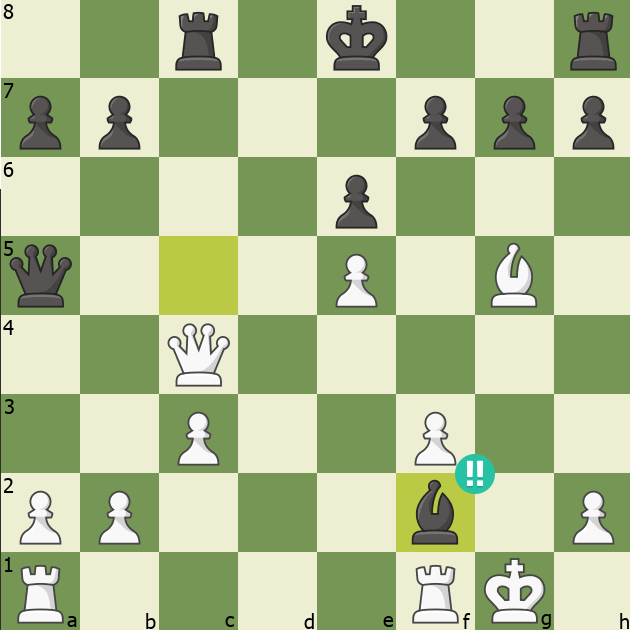
Brilliant Chess Move: Stunning Bishop Sacrifice Led to Checkmate
Most chess players have experienced it at least once. You spot a free pawn, win some material, and feel confident about your position—only to discover that your opponent had seen something much deeper.
Why Your Chess Accuracy Drops After Move 15
If your chess accuracy drops after move 15, the problem is not that you suddenly become a worse player. The problem is that the game has shifted from memory to understanding, and you have not trained that transition enough.
Why You Always Get in Time Trouble (And How Stockfish 18 Fixes It)
Every chess player knows the feeling. You navigate the opening perfectly. You transition into a solid middlegame. You build a completely fine, perhaps even slightly superior, position. And then, you glance at the clock. Your opponent has 15 minutes left. You have 42 seconds. Panic!