How to Stop Losing Winning Positions in Chess
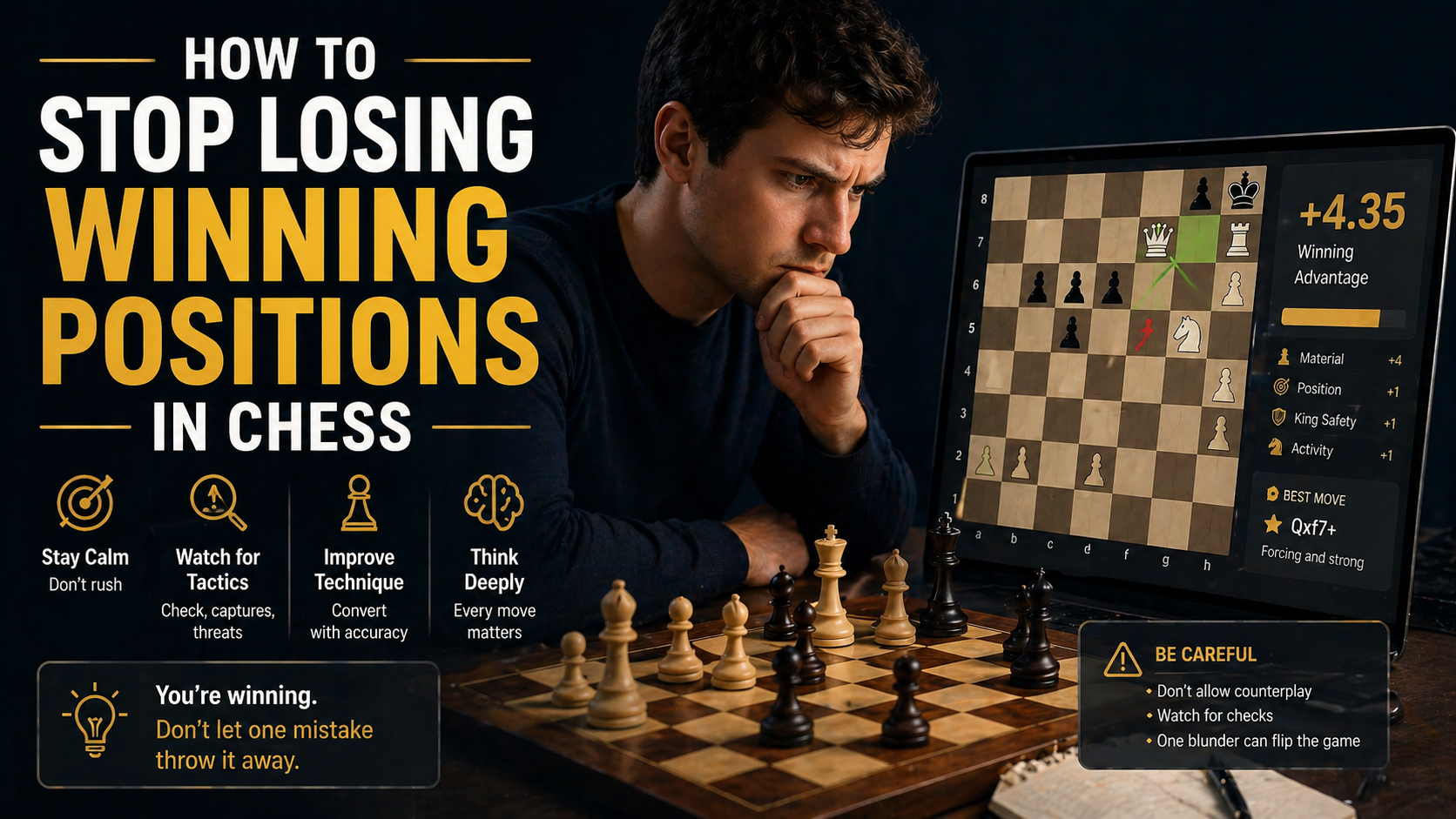
If you keep losing winning positions in chess, the problem usually is not that you “don’t know how to win.” The real problem is that once you get an advantage, your decision-making changes: you rush, force things, stop respecting counterplay, or start thinking about the result instead of the next move.
Winning more games from winning positions is not about magic. It is about learning how to simplify without switching your brain off, how to remove your opponent’s active ideas, and how to play with the same discipline when you are better that you use when the position is equal. Most players do the opposite. They become careless precisely when they should become clean.
That is why so many improving players feel stuck. They work hard to get an advantage, outplay the opponent for twenty moves, and then ruin everything with one loose tactic, one lazy queen move, one missed defender, or one unnecessary pawn grab. The pain is real, but the good news is simple: conversion is a trainable skill.
This article will show you how to stop throwing away won games, how to convert better in real practical positions, and how to build habits that make your advantage safer move after move.
Why winning positions still get lost
Being better is not the same as being finished
One of the biggest mindset errors in chess is confusing “winning” with “already won.” A position can be objectively winning and still demand five, ten, or fifteen accurate moves. Until those moves are played, the game is still alive.
This is where many players collapse. They see a plus sign in their head, relax too early, and stop treating the position like a serious calculation problem. They begin to play “result chess” instead of actual chess. They think about the point, the rating gain, the nice screenshot, or how annoying it would be to mess it up. The board immediately punishes that shift in attention.
A winning position is often more dangerous psychologically than an equal one. In an equal game, you stay alert because you know one mistake can hurt you. In a winning game, your ego whispers that the hard part is over. That whisper ruins more games than tactics do.
Winning positions create emotional noise
Many players think they blunder because they calculate poorly. Sometimes that is true. But very often the real issue is emotional noise.
When you are winning, several unhelpful thoughts appear:
“I just need to trade everything.”
“There must be a knockout here.”
“I should finish this beautifully.”
“If I mess this up, I’m an idiot.”
“I don’t want to give any counterplay, so I’ll play instantly.”
Each of those thoughts pushes you away from good decision-making. Some make you force the position too quickly. Others make you become timid and passive. Both extremes are dangerous.
The players who convert well are not necessarily calmer people. They are simply better at returning to the position itself. They keep asking the right practical question: what does my opponent want, and what is the cleanest move that keeps my advantage under control?
Advantages change shape
Another reason players lose won games is that they think every advantage should be converted the same way.
But not all winning positions are alike. Sometimes you are winning because:
You are up material.
Your opponent’s king is weak.
You have a dominant passed pawn.
You own more space and better pieces.
You have a superior endgame.
Your opponent is tied to a tactical weakness.
Each kind of advantage demands a different style of play. If you are up an exchange, simplification may help. If you are winning because the enemy king is exposed, trading queens automatically may actually release the pressure. If your advantage is positional, grabbing pawns might weaken the structure that made you better in the first place.
Many players throw away winning positions because they know they are better, but they do not understand what kind of better they are.
The first rule: do not rush because you are winning
Fast moves are often bad moves
A common pattern in failed conversions is speed. Players get an advantage and immediately try to cash it in. They stop checking tactics carefully because they believe the position should win itself.
That is when the absurd blunders happen:
Hanging a rook while trying to force a queen trade.
Missing a back-rank trick.
Taking a poisoned pawn.
Walking into perpetual check.
Allowing a stalemate trap.
None of these usually happen because the player suddenly forgot chess. They happen because the player stopped respecting the position.
When you are better, you do not need to prove it in one move. In fact, one of the strongest practical habits in chess is learning to win slowly when the position asks for it. If your opponent is tied up, worse coordinated, and low on useful ideas, you often gain more by improving your worst piece than by launching a flashy attack.
Winning slowly is still winning
A lot of club players have an unhealthy relationship with clean wins. They think a proper conversion should look forceful, immediate, and obvious. If they do not see a tactic, they begin to feel insecure.
That insecurity creates artificial complications. Instead of making a simple consolidating move, they start calculating unnecessary sacrifices and speculative forcing lines. They turn a safe advantage into a tactical mess because they want the win to look convincing.
A mature converter understands something simpler: if the position is winning, there is no need to make it dramatic. Chess does not award extra points for style. It rewards the player who keeps the position under control until the opponent runs out of resources.
Ask the quiet question
Before every move in a winning position, ask:
What is my opponent’s best active idea?
Can I stop it without giving up my own advantage?
Is there a simpler move than the first move I saw?
This is a practical filter against self-sabotage. It keeps you from turning a position into chaos when the opponent is actually the one who should suffer.
The best winning moves are often a little boring. They defend one square, centralize one piece, cut off one file, or trade one active enemy piece. Those moves rarely get applause, but they win an enormous number of real games.
How to convert a winning position in chess
1. Identify what is actually winning for you
Before choosing a plan, identify the source of your advantage.
Ask yourself:
Am I winning because I have more material?
Am I winning because my opponent’s king is weak?
Am I winning because my pieces are more active?
Am I winning because I have a passed pawn?
Am I winning because the endgame favors me?
This sounds simple, but it changes everything. If you do not know why you are winning, you will often choose the wrong conversion method.
For example, if you are up a pawn in an equal-piece endgame, trading into a simpler ending may be perfect. But if your edge comes from attacking chances against an exposed king, mindless simplification may erase your entire advantage. The board does not care that you were “better” a move ago. It only cares whether your current move preserves the thing that made you better.
Practical example
Imagine you are up a pawn, but your king is still exposed and your opponent has active rooks. If you start grabbing a second pawn instead of dealing with rook activity, you may give away perpetual checks or tactical counterplay.
Now imagine a different position where you are up a clean rook for a bishop and your king is perfectly safe. In that case, almost every trade helps you. Same feeling of “I’m winning,” completely different technical demands.
The lesson is clear: name the advantage before you try to convert it.
2. Reduce your opponent’s counterplay first
A winning position is usually lost not because the advantage vanished on its own, but because the opponent found activity.
Counterplay is the oxygen of the defending side. If you remove it, your advantage becomes easier to handle. If you ignore it, even a big edge can suddenly become awkward.
This is why strong players ask “What does my opponent want?” even when they are clearly better. They understand that defense becomes dangerous the moment the worse side gets easy active moves.
Common sources of counterplay include:
Open lines toward your king.
Passed pawns.
Active rooks behind your pawns.
Tactical checks.
Fork squares.
Perpetual-check ideas.
Stalemate tricks in queen endings.
If you can neutralize those resources without giving up your advantage, the rest of the game often becomes much easier. A player with no active plan is far more likely to collapse or drift into a lost endgame.
Good conversion is preventive
The best converting move is often not the move that wins material today. It is the move that stops all practical resistance tomorrow.
That may mean:
Trading off your opponent’s most active rook.
Tucking your king onto a safer square.
Moving a queen out of checking range.
Fixing a weak pawn before it becomes a target.
Blockading a passed pawn instead of chasing something else.
These moves are not glamorous, but they reduce the chance that your advantage will be spoiled by one tactical twist.
3. Simplify, but not blindly
“Trade pieces when ahead” is good beginner advice, but bad advanced advice if taken too literally.
Yes, simplification often helps when you are materially ahead. If you are up a queen, rook, or clean minor piece and there are no tactical complications, trading pieces usually moves the game toward a safer win.
But “trade everything” becomes dangerous when:
Your king is less safe.
The endgame is harder than the middlegame.
Your advantage depends on activity rather than material.
The trade releases your opponent’s bad position.
The only pieces creating pressure are your attacking pieces.
So the better rule is this: simplify when the resulting position is easier for you to win than the current one.
The right trade vs the wrong trade
A good trade removes your opponent’s active piece, weakens their defenses, or enters an endgame where your extra material matters more.
A bad trade may:
Swap off your best attacker.
Give the opponent a clean blockading square.
Reduce mating threats.
Transform a winning middlegame into a drawish ending.
Make your own pawns weak.
Before every trade, ask: “After this exchange, what will my advantage look like?” If the answer is vague, pause.
4. Improve your worst piece
This is one of the most underrated conversion rules in chess.
When players are winning, they often search for tactics. But if no clean tactic exists, the strongest move is frequently just improving the piece that is doing the least.
That might mean:
Bringing a rook to an open file.
Centralizing the king in the endgame.
Re-routing a knight to a strong outpost.
Connecting your rooks.
Tucking a bishop onto a stronger diagonal.
This approach keeps your position healthy while increasing the pressure on your opponent. It also prevents one of the classic mistakes of won positions: overusing the already-active pieces while leaving half the army out of the game.
A well-coordinated advantage converts more smoothly than a loose advantage. If your pieces work together, your opponent gets fewer tricks.
A simple thought process
If there is no immediate tactical win, ask:
Which of my pieces is worst?
Where would that piece like to go?
Can I improve it in one or two moves without allowing counterplay?
This often leads to practical, high-quality moves that are much stronger than forcing lines you only half understand.
5. Respect checks, captures, and threats
When you are better, the danger is not only greed. It is forgetfulness. Players start assuming the opponent has no ideas because the evaluation is favorable.
That is exactly when they forget the oldest rule in chess: always check forcing moves.
Every time it is your turn in a winning position, examine:
Checks for the opponent.
Captures for the opponent.
Immediate tactical threats for the opponent.
This habit prevents a shocking number of collapses. Many winning positions are thrown away because the stronger side calculates its own attacking idea but fails to notice one forcing defensive resource.
The harder you are winning, the more tempting it becomes to ignore your opponent’s tactical possibilities. Resist that temptation.
Why this matters even more in blitz
In fast games, players often think, “I’m winning, so I should move quickly.” In practice, this is backwards. Winning positions in blitz are exactly where one or two extra seconds can save the whole point.
You do not need a five-minute think every move. But you do need a final tactical scan before executing the move you “already know” is best. Blitz rewards strong habits, and this is one of the strongest.
6. Stop hunting beauty
A major cause of thrown wins is the desire to finish in style.
Players want:
A brilliant sacrifice.
A mating net.
A queen walk.
A flashy combination.
A perfect engine-like finish.
The result is predictable. They reject perfectly good practical moves because those moves feel too ordinary. Then they overpress, miss a tactic, or allow counterplay that never needed to exist.
There is nothing wrong with beautiful chess. But beauty is what appears after accuracy, not instead of it.
The best practical rule is brutal and healthy: if you see a simple path to a safe win, take it. Do not turn a technical win into an artistic experiment unless the position genuinely demands it.
Elegant chess is often simple chess
A lot of the positions we call “beautiful” in retrospect were not won by fireworks. They were won by clean move order, calm king safety, good exchanges, and total control.
That kind of beauty does not always feel exciting during the game. It often feels almost too simple. But simplicity is a weapon in conversion. The player with the advantage should usually be the player choosing the least risky path.
7. In endgames, activate the king and count the pawns
Many players lose winning endgames because they carry middlegame instincts into a different phase of the game.
In endgames, several priorities change:
The king becomes an active piece.
Passed pawns become central.
Tempo matters more.
One pawn move can create an irreversible weakness.
Piece coordination becomes less cluttered and more concrete.
If you are better in the endgame, one of the first questions should be whether your king is active enough. A passive king turns many winning endings into unnecessarily difficult ones.
Then count the pawn structure honestly:
Who has the healthier majority?
Which pawns are weak?
Can one side create a passed pawn faster?
Which king reaches the critical squares first?
A lot of “mysterious” lost endgames are just endgames where the better side never switched into endgame mode mentally.
Do not drift in won endgames
Won endgames feel calm, which makes them dangerous. Players stop calculating and start shuffling.
That is how they allow:
The opponent’s king to become active.
A rook to get behind the passed pawn.
A fortress to appear.
Stalemate tricks.
An easy perpetual-check setup in queen endings.
A winning endgame still needs a plan. If you cannot state your plan in one sentence, you may be drifting.
Good endgame plans are often simple:
Activate the king.
Fix a weakness.
Create a passed pawn.
Trade into a pawn ending only if it is clearly won.
Improve the rook before pushing pawns.
8. Learn the practical danger zones
Some winning positions are lost so often that they deserve special attention.
Queen endings
Queen endings are chaos machines. Even when you are up material, one loose check can change everything. Perpetual-check ideas, exposed kings, and stalemate tricks make queen endings extremely practical.
If you are winning in a queen ending:
Prioritize king safety.
Do not allow endless checking distance.
Trade queens only if the resulting ending is clearly winning.
Watch for stalemate if the opponent has almost no pieces left.
Many players lose these endings because they keep grabbing pawns while the king stays exposed.
Rook endings
Rook endings are notorious for a reason. Extra pawns do not always convert automatically, and activity matters enormously.
If you are better in a rook ending:
Activate the rook first.
Cut off the enemy king when possible.
Put the rook behind passed pawns.
Do not rush pawn pushes that create targets.
Respect checking distance.
A passive rook can spoil a winning ending surprisingly quickly.
Won attacking positions
These are the positions where players most often “feel” winning and then get hit by a defensive resource.
If you have a winning attack:
Keep your own king safe.
Calculate forcing lines fully.
Do not sacrifice just because it looks thematic.
Ask whether improving one piece makes the attack simpler.
A winning attack is still a calculation problem. Many players lose their edge by assuming the attack should finish itself.
9. Watch for stalemate and cheap tricks
Nothing is more painful than throwing away a totally won game because the opponent had no legal moves.
Stalemate is especially dangerous when:
You are up huge material.
The opponent has only a king or almost only a king.
You are checking repeatedly without a plan.
You are trying to “box in” the king too quickly.
You are moving the queen carelessly around the trapped king.
The cure is simple and practical: before every final-looking move, ask what legal move your opponent will have. If the answer is “none,” make sure the king is actually in check. If not, it may be stalemate.
This is one of the many reasons not to show off in winning positions. The flashy move is often the move that accidentally kills every escape square without delivering mate.
Cheap tricks are not beneath your opponent
When defending a lost position, good practical players become resourceful. They look for swindles, perpetuals, underpromotions, stalemate ideas, and tricks on the back rank.
Do not be offended by this. Expect it.
The stronger side often loses because it feels annoyed that the opponent is “still trying stuff.” That annoyance becomes carelessness. The right mindset is colder: of course the opponent is trying tricks. That is the job of the worse side. Your job is to remove them.
10. Build a conversion routine
The easiest way to improve this area is not to invent new wisdom every game. It is to use the same reliable conversion checklist until it becomes automatic.
Here is a practical routine:
Name the advantage.
Check the opponent’s counterplay.
Look at checks, captures, and threats.
Ask whether simplification helps.
Improve the worst piece if no tactic is clean.
Re-check king safety before committing.
In endgames, activate the king and count pawn races.
Before the final phase, check for stalemate or perpetuals.
This routine will not make every win effortless, but it will eliminate a huge percentage of unnecessary collapses.
If you keep getting winning positions and still dropping points, do not just review the last blunder. Review the conversion phase.
Use DeepBlunder to identify the exact move where your advantage started to slip, whether the problem was greed, missed counterplay, poor simplification, or a blind spot in the endgame. Then pair that work with How to Stop Hanging Pieces in Chess and the site’s recent accuracy-focused articles to clean up the practical mistakes that turn wins into disasters.
Why do I keep blundering winning positions in chess?
The short answer is that you stop playing the position and start playing the score.
You become attached to winning, which makes you impatient. You start assuming that because the position is good, any reasonable move should also be good. But chess punishes assumptions. A winning position still contains bad moves, loose squares, tactical shots, and hidden defenders.
There are also three recurring psychological errors behind thrown wins.
You become greedy
The position is already good, but you want more:
one more pawn,
one more check,
one more attack,
one more “improving” move that actually changes everything.
Greed makes players take unnecessary risks. Often the cleanest path to victory is simply not exciting enough for the ego.
You stop calculating your opponent’s ideas
This is the classic “I’m winning anyway” disease. The stronger side stares only at its own plans and forgets that every legal move still changes the board.
Many painful reversals start with one neglected resource:
a check,
a fork,
a skewer,
a perpetual,
a rook invasion,
a passed pawn push.
The cure is not fear. It is structured attention.
You switch from discipline to performance
A lot of players are more disciplined while trying to get better than while trying to finish better. As soon as the game turns favorable, they become performers instead of problem-solvers.
That shift is fatal. The board does not care whether you “deserve” the win because you played well earlier. It only rewards the move you make now.
How to train conversion instead of just hoping
Review won games you failed to win
Most players study openings, tactics, and losses. Fewer players seriously study failed wins. That is a mistake.
Your worst training material may be the games where you were completely better and did not convert. Those games reveal your real practical weaknesses:
poor simplification choices,
lazy tactical scanning,
endgame drift,
king safety neglect,
emotional impatience.
Create a personal file of thrown wins. It will be painful, but it will also be one of the most productive study collections you ever make.
Train basic technical endings
If you cannot confidently convert simple endgames, many winning middlegames will still feel unstable because you will avoid the exact simplifications that should save you.
At minimum, become comfortable with:
king and pawn fundamentals,
opposition,
rook activity,
basic rook endings,
queen vs pawn safety ideas,
mating patterns with queen and rook.
Technical confidence reduces emotional panic. When you know the simplified position is winning, you stop inventing unnecessary complications in the earlier phase.
Play training games with one goal
A good practical exercise is to start from clearly better positions and play them out against humans or engines with the sole goal of conversion. Not brilliance. Not attack. Conversion.
This isolates the skill. Instead of hoping it improves indirectly, you make it the center of the session.
Ask after each game:
Did I reduce counterplay?
Did I rush?
Did I simplify wisely?
Did I miss a forcing defense?
Did I drift in the endgame?
That is how conversion becomes a real skill instead of an emotional mystery.
A practical mindset for winning positions
When you are better, think like this:
I do not need the prettiest move.
I do not need to win immediately.
I do need to keep control.
My opponent still has resources.
Simplicity is strength if it preserves the edge.
Every move should either reduce counterplay or improve my position.
This mindset is not passive. It is professional. It keeps the game centered on practical truth rather than emotional temptation.
The strongest converters often look almost boring when they win. That is not because they lack creativity. It is because they understand timing. Creativity got them the edge; discipline collects the point.
FAQ
How do you stop losing winning positions in chess?
The best way is to slow down, identify the source of your advantage, reduce your opponent’s counterplay, and simplify only when the resulting position is easier to win. Most thrown wins come from rushing or ignoring the opponent’s active ideas.
Why do I keep blundering winning positions in chess?
Usually because you relax too early or become greedy. Once players feel winning, they often stop calculating carefully and begin forcing moves that were never necessary.
How do you convert a winning position in chess?
First figure out why the position is winning, then play moves that preserve that advantage. Good conversion usually means improving your worst piece, limiting counterplay, and choosing the safest path rather than the flashiest one.
Should you always trade pieces when ahead?
No. You should trade when the resulting position is easier for you to win. Blind simplification can ruin attacking chances or even turn a winning position into a drawish endgame.
Why do I lose winning endgames in chess?
Because winning endgames still require technique. Common mistakes include passive king play, careless pawn pushes, drifting without a plan, and allowing the opponent’s rook or king to become active.
How do you avoid stalemate in chess?
Before every final move, check whether your opponent will still have a legal move. If not, make sure the king is actually in check. If the king is not in check, the position may be stalemate rather than checkmate.
How can I stop throwing away won games in blitz?
Use a short checklist: opponent’s checks, opponent’s captures, your king safety, and the simplest winning move. In blitz, one extra tactical scan often matters more than one extra ambitious idea.
What is the biggest mistake in a winning position?
The biggest mistake is trying to finish the game before the position actually allows it. Most collapses come from impatience, not from a lack of chess knowledge.
Conclusion
If you want to stop losing winning positions in chess, start with one brutal truth: getting the advantage is only half the job. The other half is staying disciplined after the position turns your way.
Most thrown wins do not come from mysterious bad luck. They come from predictable habits: rushing, forcing, grabbing, relaxing, showing off, or forgetting that the opponent still has ideas. The fix is equally practical: identify the advantage, remove counterplay, simplify with purpose, and keep calculating even when the position feels easy.
That is what strong conversion really is. Not brilliance. Not drama. Not a perfect engine line every move. Just calm, repeatable, practical control until the position has nowhere left to go but a win.
From the same category
Keep reading
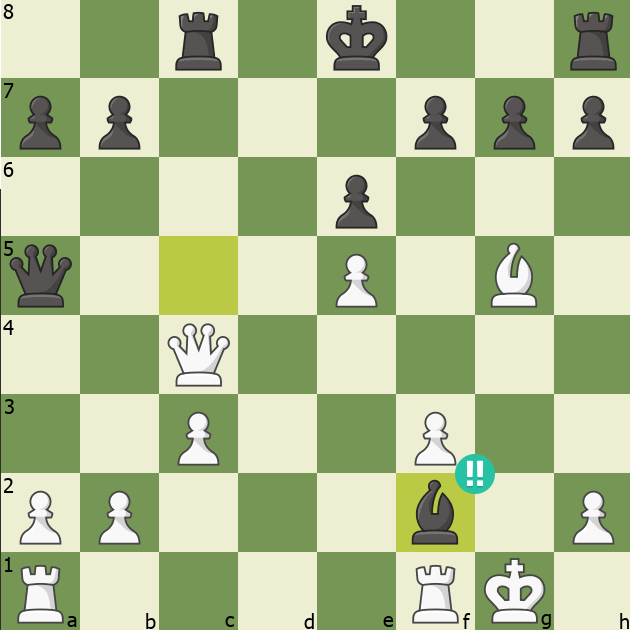
Brilliant Chess Move: Stunning Bishop Sacrifice Led to Checkmate
Most chess players have experienced it at least once. You spot a free pawn, win some material, and feel confident about your position—only to discover that your opponent had seen something much deeper.

Why Your Chess Accuracy Drops After Move 15
If your chess accuracy drops after move 15, the problem is not that you suddenly become a worse player. The problem is that the game has shifted from memory to understanding, and you have not trained that transition enough.
Why You Always Get in Time Trouble (And How Stockfish 18 Fixes It)
Every chess player knows the feeling. You navigate the opening perfectly. You transition into a solid middlegame. You build a completely fine, perhaps even slightly superior, position. And then, you glance at the clock. Your opponent has 15 minutes left. You have 42 seconds. Panic!