Why Do I Miss One-Move Threats in Chess?
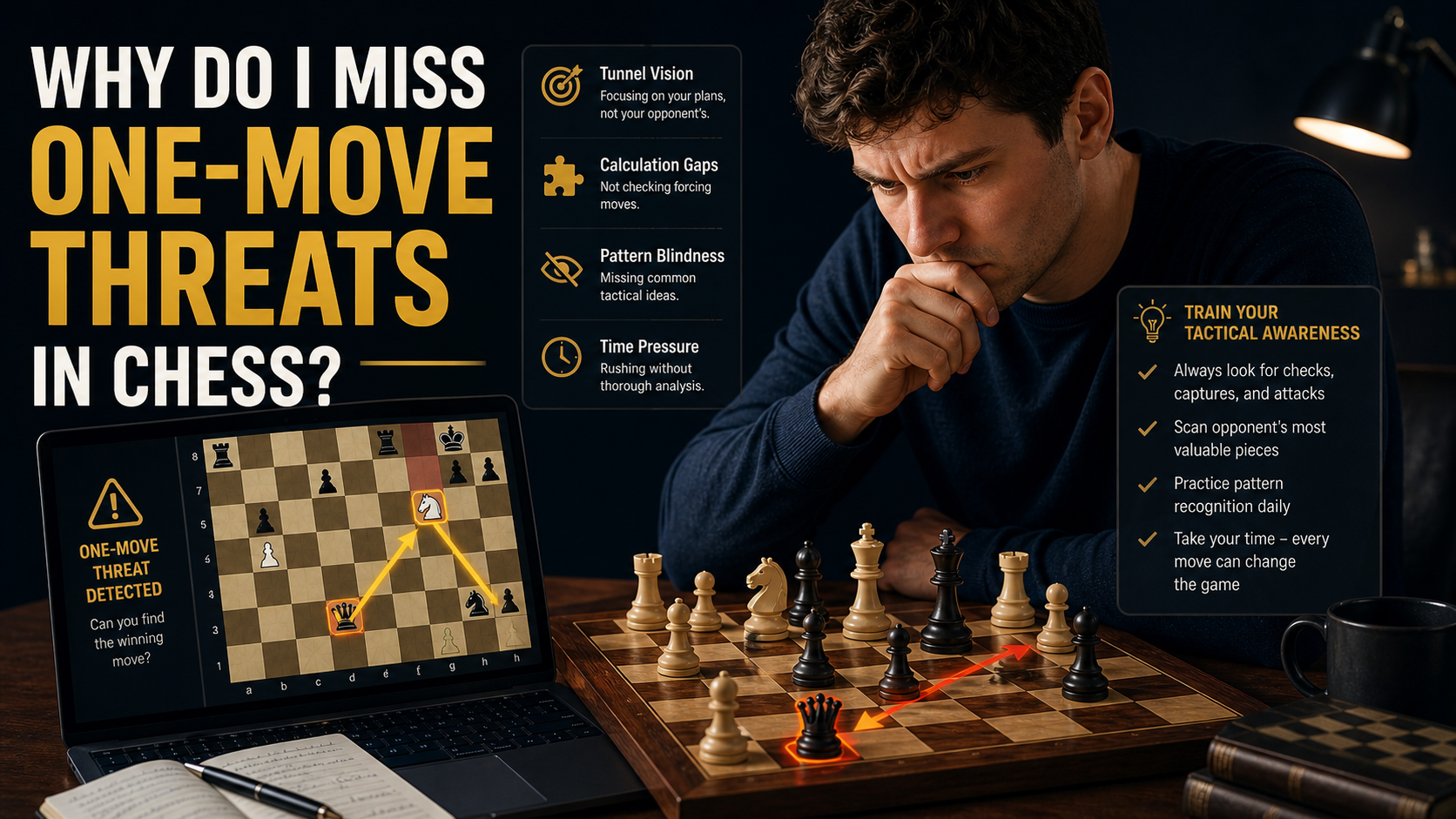
Most players miss one-move threats in chess not because they are untalented, but because they start with their own idea before they properly check the opponent’s forcing ideas. Public explanations of missed threats repeatedly point to tunnel vision, time pressure, emotional bias, and mental fatigue as common causes.
That is why the pain feels so strange. You are not usually missing a ten-move combination. You are missing something simple, direct, and sitting right there on the board. A check. A fork. A loose piece. A basic capture. A pawn break that opens your king. The move often feels obvious only after it happens.
This creates a specific kind of frustration. Players do not say, “I failed to solve a difficult calculation.” They say, “How did I not see that?” That sentence matters, because it points to the real issue. Most one-move blunders are not calculation failures in the deep sense. They are attention failures, scanning failures, or habit failures.
The good news is that this kind of blindness is fixable. Public training material on missed threats stresses that “I didn’t see it” is usually a pattern-recognition and process problem, not proof that you lack chess talent. If you improve the process that happens before calculation, you will miss fewer cheap threats, save more points, and feel calmer over the board.
What counts as a one-move threat?
A missed threat is not only a tactic that wins on the spot. One public explanation defines a missed threat more broadly as any opponent idea that would have changed your decision if you had noticed it in time.
That definition is useful because many players imagine “threat” too narrowly. They look only for dramatic forks and mating attacks. Real games are more practical than that. A one-move threat can be any move that creates immediate damage or forces you into an unpleasant concession on the next turn.
Common examples include:
A check that wins material after your king moves.
A capture on a loose piece you forgot was undefended.
A fork from a knight, pawn, or queen.
A discovered attack that appears after a simple move.
A pawn break that opens a file against your king.
A quiet move that attacks two weaknesses at once.
A move that traps a piece with no good squares.
A simple threat to win material next move unless you react.
This is why so many players underestimate the problem. They think, “I would never miss a tactic,” then lose a rook to a one-move threat that did not look tactical at first glance. The board does not care whether the move looked dramatic. If the idea was there and you did not account for it, it was a threat.
A useful mental upgrade is this: stop asking, “Is there a tactic here?” and start asking, “What can my opponent do on the very next move that would make me hate my last move?” That question is much closer to how practical chess is actually played.
Why you keep missing easy threats
You start with your own move
The most common cause of one-move blindness is simple: you begin your turn by looking at what you want to do.
This sounds harmless, but it changes the whole sequence of thought. Once your mind falls in love with an attacking move, a pawn grab, a trade, or a plan, everything else becomes harder to see. You stop scanning the board as a neutral observer and start defending your own idea emotionally.
Public explanations of missed threats describe this as tunnel vision or schematic thinking. Players focus so heavily on the plan they are executing that moves outside that plan become harder to notice. That is why one-move blunders often happen when you are attacking, pressing, or “almost winning.” Your mind has already moved forward, while the board is still living in the current position.
A lot of players think tunnel vision means they are careless. Not always. Sometimes it happens because they are too focused on a good idea. The irony is painful: the more strongly you believe your move is correct, the more likely you may be to miss the one reply that punishes it.
You assume the opponent has nothing
Another repeated theme in public discussions of missed threats is the false assumption that the opponent has no forcing ideas.
This tends to happen in three situations:
You are materially ahead.
You think the opponent’s position looks ugly.
You have just found an active move and feel in control.
In all three cases, the same silent thought appears: “What can they really do?” That thought is poison.
A worse position can still contain checks. A cramped position can still contain forks. A passive-looking move can still hide a tactical reply. In practical chess, the side that looks worse often survives precisely because the stronger side stops asking serious questions.
One-move threats thrive on disrespect. The moment you assume there is “nothing there,” the board punishes you.
You calculate too late
A surprisingly common habit is this: a player chooses a move first and only then starts checking whether it works.
That sounds backwards because it is backwards. But many improving players do it without noticing. They see a move they like, touch it mentally, and then begin the verification step. By that point, their calculation is already biased.
This is where blunders become sticky. Once the mind has invested in a move, it tends to look for confirmation instead of danger. It asks, “How does this work?” rather than “Why might this fail?” That tiny psychological shift is enough to miss a one-move tactic.
Better players do not avoid candidate moves. They just delay commitment. They let the move sit in front of them without emotionally marrying it. That makes it easier to see the ugly reply.
Time pressure and mental fatigue are real
Missed threats are not only conceptual. They are physical and emotional too. Public discussion of this problem points to time pressure, mental fatigue, lack of focus, haste, and positional distraction as major reasons easy tactics get missed.
That matters because it stops you from making the wrong diagnosis. If you miss a one-move threat in the fourth hour of a classical game, the lesson is not necessarily “I do not understand tactics.” It may be “My process collapsed under fatigue.” If you miss it in blitz after moving instantly three times in a row, the problem may be haste rather than knowledge.
This does not excuse the blunder. It clarifies it. You fix different causes in different ways. A pattern issue needs a pattern fix. A time issue needs a time-management fix. A fatigue issue needs a practical routine that survives low energy.
The players who improve fastest are not always the players who blame themselves hardest. They are the players who classify the mistake correctly.
You think seeing threats means calculating more
This is another trap. Many players respond to missed threats by trying to calculate deeper.
Sometimes that helps, but public explanations suggest that many missed threats happen before deep calculation even begins. The move is missed not because the player failed to analyze five branches, but because the critical move never entered the candidate list.
That distinction is huge. If a threat never enters your field of view, more calculation will not save you. You will simply calculate the wrong world in greater detail.
The solution is to improve scanning before calculation:
What changed after the opponent’s move?
Which pieces became loose?
Which lines opened?
Which checks, captures, or direct attacks are now possible?
What is the most annoying move they could play next?
This is why simple routines beat heroic thinking. You do not need to become a calculation monster to cut one-move blunders. You need a process that forces danger into view before your ego gets busy.
The real skill: seeing the board from the other side
One-move threat detection is not mainly about cleverness. It is about perspective.
Most amateurs look at the board from the “I want” angle:
I want to attack.
I want to trade queens.
I want to win this pawn.
I want to improve this bishop.
I want to finish this game.
Strong practical players spend more time in the “they want” angle:
What is their best check?
What are they attacking now?
Which of my pieces became vulnerable?
If I make my intended move, what hurts me next?
What would they play instantly if it were their turn again?
That second viewpoint is the cure.
When you start seeing positions from the opponent’s chair, one-move threats become less mystical. You stop feeling ambushed by obvious tactics and start noticing them earlier. The board becomes less about your intentions and more about shared reality.
This is also why blunder reduction and threat detection belong together. DeepBlunder’s recent content on hanging pieces and losing winning positions is built around the same principle: many painful mistakes come from incomplete board awareness, not lack of ambition.
How to stop missing one-move threats
1. Start every turn with the opponent’s last move
Before you even look for your move, ask one disciplined question:
What changed after my opponent’s last move?
This is not glamorous, but it is transformative.
Look for:
New attacks.
New defenders.
Newly opened lines.
Newly loose pieces.
A change in king safety.
A move that threatens something simple next turn.
Most one-move threats are visible in the change, not in the whole position. The opponent’s last move created something. Your job is to identify what that something is before you start dreaming about your own plan.
A useful habit is to phrase it out loud in training: “Their last move attacks my knight,” or “Their last move opens the bishop onto my rook,” or “Their last move threatens a fork.” That sentence alone can prevent a huge number of cheap losses.
2. Use the checks-captures-threats scan
A lot of chess advice says “look for checks, captures, and threats,” and there is a reason the phrase survives. It works.
But you need to apply it from the opponent’s side first.
Before every move, scan:
What checks do they have?
What captures do they have?
What immediate threats do they have?
Only after that should you scan your own forcing options.
This is not a beginner crutch. It is a practical filter that remains useful at every level below master play, especially in rapid and blitz. It does not solve every tactical problem, but it cuts the stupidest blunders—the ones that make you angry long after the game ends.
The key is consistency. A good routine does not need to be brilliant. It needs to survive stress, speed, and ego.
3. Do a blunder check on the move you want to play
Once you have chosen a candidate move, pause and ask:
What will my opponent do if I play this?
What are their forcing replies?
Does any piece become loose after my move?
Does any line open toward my king?
Am I allowing a fork, skewer, or discovery?
If I were trying to punish this move, how would I do it?
This is where many blunders die. The move may still be good, but you have given the board one last chance to object.
The important part is emotional tone. Do not ask the question in a lazy way, hoping the answer is “nothing.” Ask it like a prosecutor. Assume the move is guilty until proven safe.
That small shift makes your own ideas less seductive and your board vision more honest.
4. Classify the threats you miss
One public explanation of missed threats suggests that labeling the type of threat is more useful than merely memorizing the position.
That is excellent practical advice.
After a game, do not just say, “I missed a tactic.” Be more specific:
Missed check.
Missed loose-piece capture.
Missed knight fork.
Missed pawn break.
Missed discovered attack.
Missed back-rank threat.
Missed quiet improving move.
Missed stalemate or perpetual idea.
When you classify the threat, patterns emerge. Maybe you rarely miss line tactics but often miss pawn moves. Maybe you are fine in equal positions but blind after winning material. Maybe your biggest weakness is not tactics in general but quiet threats after trades.
Specific mistakes produce specific improvement. Vague regret produces nothing.
5. Slow down at danger moments
Not every move deserves the same amount of time.
There are positions where missing one move is much more likely:
Right after a trade.
Right after the center opens.
When kings are exposed.
When a piece becomes loose.
When you are about to win material.
When you think the game is “basically over.”
When the opponent makes a move that looks too simple.
These are danger moments. Your clock habits should reflect that.
The worst time to move quickly is when the position has just changed shape. If a file opened, a diagonal cleared, or one defender disappeared, that is exactly when one-move threats are born.
A lot of players save time in the wrong places and spend it in the wrong places. They think longer in static positions and move instantly after tactical changes. Reverse that pattern and your chess will become safer immediately.
6. Respect quiet moves
Players usually fear forcing moves and disrespect quiet ones.
That is a mistake.
A quiet move can:
attack two pieces indirectly,
improve a defender,
trap a bishop,
prepare a discovered attack,
create an unstoppable mating threat,
threaten a tactical idea on the next move.
Public training material on missed threats includes these “quiet” ideas as real threats, not minor decorations. That is important because many practical blunders are not against checks or captures now, but against a simple improvement move that makes the next tactic unavoidable.
If a move seems “harmless,” that should be a trigger to inspect it more carefully, not less. Harmless-looking moves are where lazy board vision goes to die.
A practical routine you can use in every game
If you want one routine that is short enough to remember and strong enough to matter, use this:
Before your move
What changed after their last move?
What are their checks, captures, and threats?
Which of my pieces are loose?
Is my king fully safe?
What move do I want to play?
What is their most annoying reply?
If I still like my move, play it.
That is it.
It is not a magic spell. You will still miss things sometimes. Everyone does. But this routine dramatically improves the odds that the threat at least enters your awareness before it crashes into your game.
The point is not to become paranoid. The point is to become structurally aware. There is a difference. Paranoid players see ghosts. Structured players see possibilities.
Why one-move threats hurt even strong amateurs
The most embarrassing blunders are usually the shallow ones.
Miss a difficult tactical resource and you can live with it. Miss a one-move threat and it feels personal. It feels like the board insulted you.
That emotional reaction makes sense. Public discussion of the issue highlights tunnel vision and psychological bias because these mistakes often happen when the move should have been easy to see. It is not just that you lost material. It is that the mind cannot accept how simple the punishment was.
But that pain can be useful. One-move blunders often reveal the most fixable layer of your game. You do not need a year of opening work to cut them. You need better move-order discipline, better scanning, and a calmer process under pressure.
In other words, this is one of the highest-return improvement areas in chess. If you reduce cheap threat blindness, your rating can rise without any dramatic change in your strategic understanding.
How this connects to the rest of your game
Missed threats and hanging pieces
Many players think hanging pieces and missed threats are separate problems. They are often the same problem wearing different clothes.
You hang pieces because you fail to notice an attack.
You miss threats because you fail to notice an attack.
Both come from incomplete board scanning.
That is why this article pairs naturally with DeepBlunder’s anti-blunder guide. The same habit that saves your rook from a fork will also save your position from an immediate tactical threat.
Missed threats and lost winning positions
DeepBlunder also recently covered the problem of throwing away winning positions, and the overlap here is large. Players often lose winning games not because the position was hard, but because once they felt safe, they stopped checking the opponent’s simplest ideas.
This is one of the cruelest patterns in practical chess:
You outplay the opponent.
You win material.
You relax.
You miss one move.
The whole game turns.
That is why threat awareness matters even more when you are better. Success makes amateurs careless. Strong routines prevent that.
Missed threats and accuracy anxiety
Players who obsess over post-game accuracy often misunderstand what their bad games are telling them. One ugly accuracy number may reflect not a huge strategic collapse, but a few cheap threats that caused major evaluation swings. DeepBlunder’s recent accuracy pieces already touch that broader connection between practical error rate and overall game quality.
This is useful because it keeps your training honest. The cure for some bad games is not memorizing deeper theory. It is simply seeing the move your opponent was threatening on the next turn.
That may sound too basic to matter. It matters a lot.
If you keep saying “I just didn’t see it,” stop treating that as bad luck.
Use DeepBlunder to review the exact moment a threat first appeared, not only the move where the tactic landed. That is where the real lesson lives.
Pair this with How to Stop Hanging Pieces in Chess and How to Stop Losing Winning Positions in Chess to clean up the same awareness problem from both sides.
Mistakes to stop making immediately
Stop moving because a move “looks natural”
Natural moves are responsible for a shocking number of unnatural disasters.
Just because a rook belongs on an open file, a knight belongs in the center, or a queen trade looks sensible does not mean the move works now. One-move threats often punish exactly the move that looked most normal.
The board has no respect for “principled” moves that ignore tactics.
Stop assuming your last move was safe because it was good
A move can be strategically sensible and tactically flawed.
This is one reason practical players struggle. They correctly understand the plan, but they execute it on the wrong move. Then a one-move threat appears and ruins the idea before it begins.
The lesson is hard but important: good plans still need legal, tactically safe moves.
Stop reviewing only the final blunder
If the tactic landed on move 31, the real mistake may have happened on move 29, when you ignored the warning signs.
Public guidance on missed threats is helpful here because it frames the issue as a habit problem rather than a single bad move. That means your review should go earlier:
When did the square become weak?
When did the file open?
When did the piece become loose?
When did the opponent’s idea first become visible?
That is where prevention lives.
Training plan: how to fix this in two weeks
If you want a realistic short-term reset, try this:
Days 1-3: Threat tagging
Review recent games and classify every missed one-move threat.
Do not solve deeply.
Just label the mistake type.
Days 4-6: Opponent-first routine
In every game, begin every move with the same scan:
their checks, captures, threats.
Do not worry about brilliance.
Days 7-9: Slow down at changes
Any time a file opens, a trade happens, or a king becomes exposed, force yourself to pause.
Days 10-12: Quiet-move awareness
Look specifically for non-forcing threats:
piece traps, improved defenders, simple attack-builders.
Days 13-14: Post-game audit
After each game, answer three questions:
What did I miss?
When did it first become possible?
Which habit would have caught it?
This is not a glamorous program, but it is practical. The goal is not to “be more talented.” The goal is to install a repeatable process that still works when you are tired, rushed, or emotionally invested.
FAQ
Why do I miss one-move threats in chess even when I know the patterns?
Knowing the pattern is not the same as seeing it in the live position.
Most players miss one-move threats because their attention goes first to their own plan, not to the opponent’s immediate ideas.
That creates tunnel vision, and tunnel vision can hide even familiar tactical patterns.
In many cases the threat was not too hard to calculate; it simply never entered the candidate list in time.
This is why the fix is often procedural rather than theoretical.
If you start each move with the opponent’s checks, captures, and threats, patterns you already “know” become much easier to notice.
How do I stop missing threats in blitz?
You will not eliminate all missed threats in blitz, but you can cut the worst ones fast.
The key is to use a smaller routine instead of trying to calculate everything.
Before every move, scan the opponent’s checks, captures, and threats first, then choose your move.
Public discussion of missed tactics points to haste and lack of focus as major causes, so a two-second danger scan is often more valuable than one extra ambitious idea.
Also slow down when the position changes sharply, especially after trades, checks, or center breaks.
Blitz punishes deep confusion, but it also rewards short, reliable habits that survive speed.
Are missed one-move threats a tactics problem or a psychology problem?
Usually they are both, but the psychological side is often bigger than players want to admit.
Public explanations of missed threats repeatedly mention tunnel vision, emotional bias, time pressure, and fatigue.
That means the issue often begins before deep calculation starts.
You may have the tactical knowledge, but your mental process may be filtering the board badly.
In practical terms, this is good news, because process is easier to improve than raw talent.
If you train attention, scanning, and move-order discipline, your tactical results often improve even before your calculation depth changes.
Why do I miss easy tactics more when I am winning?
Because winning changes your mindset.
When players feel better, they often assume the opponent has no dangerous ideas left, and that is exactly when cheap threats become most effective.
You also become more likely to rush, simplify blindly, or focus on “finishing” instead of checking what the opponent can still do.
That makes one-move threats feel especially cruel in winning positions.
The cure is to keep the same routine when you are better that you use in equal positions.
Winning does not remove the need for board awareness; it makes it even more important.
What should I look for before every move?
Start with the opponent’s last move and ask what changed.
Then check their forcing options: checks, captures, and immediate threats.
After that, look for your loose pieces, your king safety, and any line that just opened.
Only then should you return to the move you want to play.
This routine works because many missed threats happen before calculation begins, not deep inside it.
If you keep the order consistent, you will catch far more danger without needing to think for five minutes every move.
How should I review a game after I miss a one-move threat?
Do not review only the final tactic.
Go back one or two moves and find the first moment the threat became possible.
Then classify the threat clearly: check, fork, loose-piece capture, pawn break, quiet threat, or discovered attack.
This matters because classification reveals patterns that random regret hides.
Over time you may notice that you miss the same type of threat again and again.
Once that pattern is visible, your training becomes much more targeted and much more effective.
Conclusions
Missing one-move threats in chess feels embarrassing because the move usually looks obvious after the fact. Public explanations of the problem consistently point to tunnel vision, time pressure, mental fatigue, and emotional bias, which means the issue is often less about deep calculation and more about what your mind notices first.
That is why the most useful fix is not “calculate harder.” It is “look better.” Start every move with the opponent’s last move, scan checks-captures-threats from their side, and only then return to your own candidate move. This simple shift catches a huge percentage of the blunders that make practical chess so painful.
The bigger lesson is even stronger: one-move threat blindness is not proof that you lack chess ability. It is usually proof that your process breaks under speed, emotion, or habit. And that is good news, because processes can be rebuilt. Once they are, the board starts looking calmer, cleaner, and much less hostile.
From the same category
Keep reading
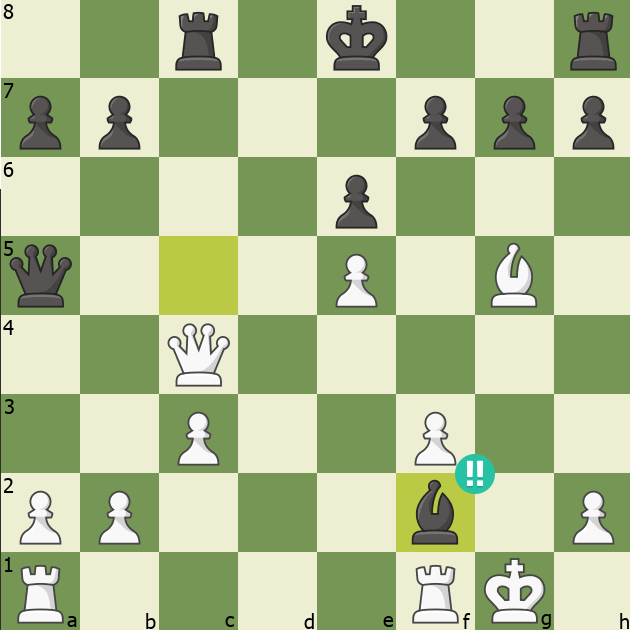
Brilliant Chess Move: Stunning Bishop Sacrifice Led to Checkmate
Most chess players have experienced it at least once. You spot a free pawn, win some material, and feel confident about your position—only to discover that your opponent had seen something much deeper.
Why Your Chess Accuracy Drops After Move 15
If your chess accuracy drops after move 15, the problem is not that you suddenly become a worse player. The problem is that the game has shifted from memory to understanding, and you have not trained that transition enough.
Why You Always Get in Time Trouble (And How Stockfish 18 Fixes It)
Every chess player knows the feeling. You navigate the opening perfectly. You transition into a solid middlegame. You build a completely fine, perhaps even slightly superior, position. And then, you glance at the clock. Your opponent has 15 minutes left. You have 42 seconds. Panic!