Is 97% Accuracy Cheating in Chess? What 75%, 80%, 95%, 98% and 100% Accuracy Really Mean
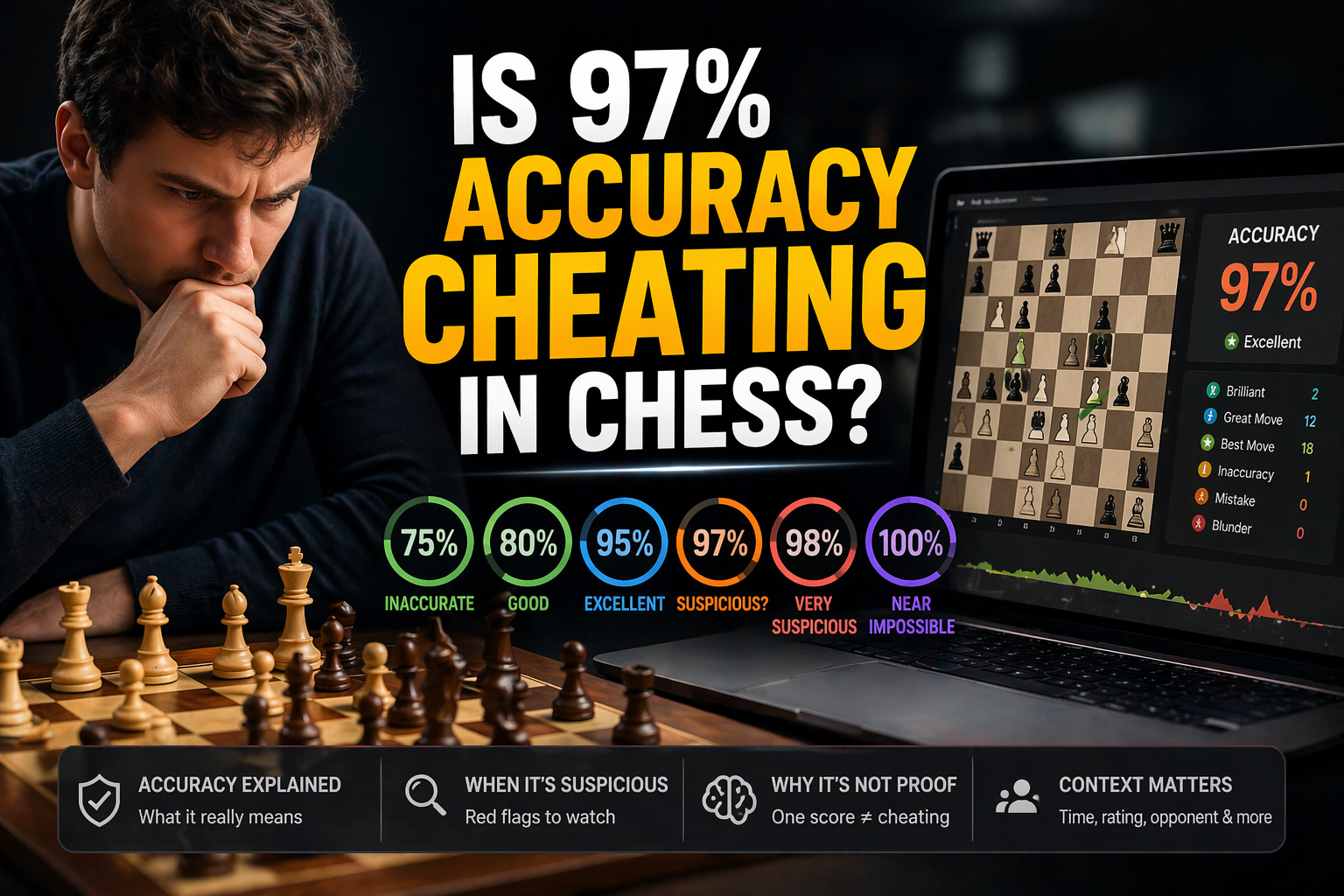
If you just finished a game and saw 97% accuracy, your first thought might be, “That has to be cheating.” The short answer is no: a single 97% accuracy game is not automatic proof of engine use, and Chess.com explicitly says accuracy is not cheat detection.
The better question is not “What percentage is cheating?” but “What does this number mean in context?” That shift matters because accuracy is a performance snapshot from one game, not a courtroom verdict, not a rating replacement, and not a standalone anti-cheating test.
For players trying to rank on Google, this is also where most articles get the topic wrong. They chase a dramatic claim about 97%, 98%, or 100% accuracy, when the real answer is more nuanced: some accuracy scores are excellent, some are ordinary, some are suspicious, but no single number proves cheating by itself.
Is 97% accuracy cheating in chess?
No. A 97% game can be completely legitimate, especially if the game was short, theory-heavy, highly forcing, or if the opponent made the position easy to play. Chess.com says directly that high accuracy is not the same thing as cheat detection.
Is 97 percent accuracy good in chess?
Yes, 97% accuracy is a very strong game. It usually means your moves were extremely close to engine-approved play in that specific position, but it still does not mean you played like a machine across many games.
What level of accuracy is cheating in chess?
There is no official “cheating percentage.” Fair-play systems use many gameplay and behavioral factors, not one headline number, and Chess.com says its detection works across more than 100 gameplay factors.
Is 75% accuracy good in chess?
Usually, yes. For many improving and club-level players, 75% can be a decent game, especially if the position was complex, the clock was low, or the game was long. Community benchmarks commonly place many sub-1500 players in roughly the 70% to 80% range.
Is 80% accuracy good in chess?
Yes. In practical terms, 80% often means you played a solid game with manageable mistakes rather than a collapse full of blunders. Many players describe 80% as the point where a game starts to feel clean and well-controlled.
Is 95% accuracy good in chess?
Absolutely. A 95% game is excellent, but it can happen naturally, especially in short games, forcing lines, or positions where the best moves are easier to find than they look from the outside.
Is 98% accuracy good in chess?
Yes, 98% is exceptional. It is rare in ordinary long games, but it can appear in theoretical openings, sharp tactical sequences, or short wins where there are only a few serious decisions.
How rare is 100% accuracy in chess?
100% accuracy is possible, but it becomes much rarer as games get longer and less forcing. Community discussions consistently note that perfect scores are most realistic in short games, opening-heavy games, or games where one side collapses quickly.
Accuracy bands at a glance
Accuracy bandPractical meaning75%Usually a decent result for many improving players, especially in complex or longer games; community estimates often place a large share of 1000-1499 players around the 70-80% zone. 80%A solid, clearly good game for many club players and often a sign that you avoided major damage. 95%Excellent performance in one game, but still not proof of cheating. 97-98%Exceptional single-game accuracy, often seen in short, forcing, or theory-friendly games as well as genuine peak performances. 100%Possible, especially in short or heavily forced games, but far rarer in long, messy human battles.
What chess accuracy actually measures
Accuracy is about move quality, not reputation
On Chess.com, accuracy is presented as a way to show how closely your play matched strong computer recommendations against the moves your opponent actually made. In other words, it is a game-level quality score, not a label on your identity as a player.
That distinction is important because players often misuse the number. They see 95% and think “engine,” or they see 75% and think “bad player,” when both reactions miss the real point. Accuracy is descriptive before it is diagnostic.
A good analogy is a photo taken during one moment of a marathon. If the picture catches you sprinting downhill, it does not prove you ran the entire race at the same speed. A single chess accuracy score works the same way.
Accuracy is not just “best moves divided by moves played”
Public explanations from the chess community note that accuracy is not simply a raw count of best moves. It is tied to how costly your deviations were from stronger engine choices, which is why one “good” move in a complicated position may be worth more than five easy recaptures in a forcing line.
That also explains why two games with the same final percentage can feel completely different. One 85% game may contain deep strategic decisions and one late blunder, while another 85% game may be almost entirely routine until both players scramble in time trouble.
Why the same player can score 55% one day and 97% the next
Chess is extremely sensitive to game shape. If your opponent blunders early, gives you forcing moves, or walks into opening preparation, your accuracy can shoot upward because the best moves become easier to find.
If the game becomes closed, murky, strategic, and full of non-forcing options, accuracy often falls even for strong players because there are more chances to choose a merely good move instead of the engine’s top move. Community discussions repeatedly point out that shorter and more forcing games produce higher and more volatile accuracy scores.
That is why experienced players look beyond the number. They ask:
Was the game short?
Were many moves forced?
Did the opening stay in theory for a while?
Was one side already losing, making the winning plan easier?
Was there a tactical sequence where only a few obvious moves existed?
Those questions usually explain the score better than the score explains the game.
Is 97% accuracy cheating in chess?
The direct answer
No, 97% accuracy is not automatically cheating. Chess.com states clearly that high accuracy is not cheat detection and that a player can achieve a high score in a single game for many legitimate reasons.
This is the most important sentence in the whole topic, and it deserves to be stated without hedging. A fair-play system does not work by saying, “97% equals guilty.” If it did, it would falsely punish a lot of honest players who simply had one clean, easy, or well-prepared game.
Why 97% happens naturally
A legitimate 97% game can happen in several normal scenarios:
You played an opening you know very well.
Your opponent made the position simple.
The game stayed tactical and forcing.
The game ended before many hard strategic decisions appeared.
You converted a winning position without giving counterplay.
This is why lower-rated players sometimes post surprisingly high numbers. Even an 800-rated or 1000-rated player can have one near-perfect game if the structure is familiar and the opponent helps them by making bad decisions early. Community discussions around 95% to 99% games reflect exactly this point.
When 97% becomes suspicious
A single 97% game is not suspicious by itself. A pattern of repeated, highly accurate games combined with overperformance and non-human-looking behavior is much more relevant than one standout result.
This is also consistent with how modern fair-play systems are described publicly. Chess.com says its detection uses more than 100 gameplay factors and a combination of statistical and behavioral signals, not just one visible post-game score.
So if your opponent scored 97% once, that tells you almost nothing. If they score unnaturally high results again and again, across many serious decisions, with suspicious timing and extreme consistency, that is a different conversation.
What level of accuracy is cheating in chess?
There is no magic number
The cleanest answer for snippet purposes is this: no single accuracy percentage proves cheating in chess. There is no official threshold where 94% is innocent, 95% is doubtful, and 97% is guilty.
This is not a dodge. It is the only honest answer. Chess.com’s public fair-play explanation emphasizes that accuracy is not cheat detection, and its actual systems analyze millions of games using many more inputs than one percentage. From January through March 2025 alone, Chess.com says it analyzed about 20 million games per day and closed about 314,000 accounts for fair-play violations.
That scale matters because it shows why simplistic public myths do not match real detection practice. A platform handling that volume cannot rely on a one-number rule, and according to Chess.com, about 85% of closures are automated after a combination of signals indicates extremely improbable performance.
What fair-play teams care about more than one score
A serious anti-cheating review is more likely to care about patterns such as:
Repeated overperformance over many games.
Move quality staying abnormally high in hard positions.
Behavioral signals and account data beyond the moves themselves.
Timing patterns that look unnatural across decision types.
Consistency that is too strong to match the player’s established level.
This is also why casual accusations are often wrong. People remember the 98% game that hurt them and forget the ordinary 71% game they never checked. Human memory is emotional; fair-play systems are statistical.
False positives are a real concern
Chess.com also acknowledges that false positives are part of the challenge and says it tries to balance fast enforcement against wrongful closures. The site reports that it reviewed about 28,000 appeals in the first three months of 2025 and granted only 0.2% of them.
That does not mean the system is perfect, but it does show the topic is more serious than social-media certainty. “He had 97%” may feel persuasive in a chat window, yet it is not the standard public fair-play systems claim to use.
Is 75% accuracy good in chess?
In most practical cases, yes
For many beginners and club players, 75% is a respectable result. It usually means you made some inaccuracies or one larger mistake, but you were not simply hanging material every few moves.
The key phrase is “for your level.” A 75% game from a beginner can be encouraging progress, while a 75% game from a master in a comfortable position may feel sloppy. Accuracy only becomes useful when paired with rating level, time control, and game difficulty.
Why 75% often looks better than players think
Most amateur games are messy. There are missed tactics, imprecise recaptures, unclear plans, and time-trouble moves that are nowhere near engine-perfect. In that world, 75% can reflect a player who handled the essentials correctly and made only a handful of meaningful errors.
Many players are disappointed when they see 74% or 76% because they compare themselves to online content featuring elite accuracy numbers. That is a mistake. Strong players are not judged by your scoreboard, and your training goal should be fewer recurring errors, not prettier percentages.
When 75% is actually strong
A 75% score can be quietly impressive when:
The game was long.
The middlegame was strategically complex.
Both sides had many viable options.
The time control was fast.
There were defensive resources to find under pressure.
In those cases, a 75% game may reflect real skill. A hard 75% can be more valuable than an easy 92%.
Is 80% accuracy good in chess?
Yes, 80% is a solid benchmark
For many club players, 80% is where a game starts to feel genuinely well played. Community discussions often describe anything above 80 as a “good game,” especially if the game went beyond the opening and involved real decisions.
That does not mean 80% is elite. It means you likely avoided catastrophic mistakes and kept your position within a reasonable distance of strong engine play. For improvement purposes, that is a very healthy place to be.
Why 80% matters more than people think
An 80% game often suggests that your basics are holding:
You are not blundering as often.
You are converting easier advantages more cleanly.
You are recognizing obvious tactics.
You are choosing workable plans instead of random moves.
That is a much better sign of chess growth than one lucky 96% game. Improvement is built on repeatable quality, and 80% games are often more repeatable than near-perfect ones.
Improve the number behind the number
If you want better accuracy without obsessing over vanity percentages, use DeepBlunder as your post-game training layer. Review where your score actually dropped, separate opening memory from real decision-making, and find whether your recurring losses come from tactics, strategic drift, or time trouble.
Suggested CTA block to paste into the article:
Use DeepBlunder to analyze your last games by phase, spot repeated mistakes, and train the positions that cost you the most points. One score is interesting; a pattern is useful.
Is 95% accuracy good in chess?
95% is excellent
Yes, 95% accuracy is very good. In most practical settings, it means you played an excellent game with very few costly mistakes.
But excellent does not mean suspicious by default. Chess.com says high accuracy in one game can happen for many legitimate reasons, and community discussion around strong single-game scores repeatedly points to short, forcing, or theory-based games as natural explanations.
Why 95% can happen honestly
You may see 95% when:
You know the opening well.
The opponent chooses a bad plan and the punishment is straightforward.
The position simplifies early.
The tactical ideas are clear.
The game ends before a long technical endgame introduces harder choices.
This matters because many players ask the wrong question after losing. Instead of asking, “Was 95% cheating?” they should ask, “Did I make the position easy for my opponent?” In chess, bad resistance often inflates the winner’s accuracy.
Is 98% accuracy good in chess?
98% is exceptional, not impossible
A 98% game is outstanding. It usually means the game contained very few meaningful inaccuracies at all.
Still, even 98% is not automatic proof of cheating. A short miniature, a forcing tactical line, or a familiar opening sequence can naturally create very high scores. Chess.com’s public position remains the same: accuracy is not cheat detection.
When 98% should not surprise you
You should not be shocked by 98% if:
The game was under 20 moves.
One side walked into prepared theory.
The loser made one or two early strategic errors that made the rest easy.
The winning side only had a few critical choices.
The final sequence was basically forced.
High accuracy becomes more impressive when the game is long, rich, and resistant. The percentage matters more when the path was hard.
How rare is 100% accuracy in chess?
Possible, but context decides the rarity
100% accuracy is possible in chess. Community discussions agree on that broad point, but they also stress that the score becomes far less common once games get longer and more complex.
The reason is simple: every additional decision creates another chance to choose a move that is good but not engine-best. So the probability of staying perfect tends to shrink as the game adds strategic branches, defensive resources, and non-forcing moments.
Why short games inflate perfect scores
If a game follows opening theory, then shifts into a forcing tactical sequence, perfect or near-perfect accuracy becomes much easier to imagine. Some short games are practically scripted by opening knowledge plus one decisive mistake.
That is why “How rare is 100% accuracy?” needs a second clause: “In what kind of game?” In a 12-move miniature, it is notable but not shocking. In a long, balanced middlegame battle with multiple turning points, it is dramatically rarer.
The practical takeaway
If you ever score 100%, enjoy it. It usually means one of three things:
The game was short.
The position was heavily forced.
You played a genuinely brilliant game.
Just do not turn it into a false benchmark. Chasing 100% is a bad training goal. Making fewer repeat mistakes is the right one.
What affects chess accuracy more than players realize
1. Game length
Short games regularly produce higher accuracy because there are fewer opportunities to drift away from the top engine line. This idea appears again and again in community discussion around 95% to 100% games.
2. Opening familiarity
If you know the opening and your opponent does not, your moves may be both easy and strong. A prepared player can look engine-like for perfectly human reasons.
3. Forcing positions
Checks, captures, threats, and tactical sequences narrow the decision tree. When there are only one or two sensible moves, accuracy naturally rises.
4. Opponent quality
A bad opponent can make your game easier. If they hand you targets, weak squares, and straightforward tactics, your percentage may jump because the best moves become obvious.
5. Time control
Fast games often create chaos, but they can also create inflated scores when one player’s decisions are obvious and the other side collapses. Longer time controls may reduce blunders but increase the number of subtle strategic choices.
6. Position type
Closed strategic positions often hurt accuracy because there are many reasonable plans and engines may strongly prefer one precise route. Community discussion notes that complicated, closed positions can send accuracy downward even without anything suspicious happening.
When should you actually be suspicious?
Red flags are about patterns, not headlines
If you want the honest answer to “What level of accuracy is cheating in chess?” it is this: suspicion starts with repeated patterns, not one visible percentage. That matches the public explanation from Chess.com much better than social-media folklore.
A stronger warning profile looks like this:
Unusually high accuracy over many games.
Strong play specifically in the hardest moments.
Consistent overperformance relative to established level.
Unnatural timing behavior.
Moves that are strong, but also weirdly engine-like in situations where humans usually simplify or choose practical continuations.
What to do instead of guessing
If you suspect cheating, use the platform’s report function and move on. Chess.com says reports trigger review of the player’s recent games, and its fair-play team combines automated systems with analyst review.
This is a healthier approach than public accusation. It protects honest players from casual witch hunts and lets trained systems look at more than the one game that upset you.
How to use accuracy for improvement without misunderstanding it
Treat accuracy as a clue
The best use of accuracy is not ego management. It is diagnosis. If your score is low, ask where the drop came from:
Opening misunderstanding.
Tactical miss.
Strategic misread.
Endgame technique.
Time trouble.
That question turns a vanity number into training value. A player who learns from a 72% game improves faster than one who celebrates a 94% game and studies nothing.
Track clusters, not single scores
A more useful habit is to review your last 20 or 30 games and look for patterns:
Do you score well in known openings but collapse in original positions?
Do your scores drop after move 20?
Is blitz accuracy much worse than rapid?
Are your bad games tactical or strategic?
Do your wins hide recurring weaknesses?
That is the real improvement framework. Even Chess.com describes fair-play review as pattern-based and data-rich, not anchored to a single visible score, and that same mindset helps honest players improve too.
Use internal links naturally
To strengthen topical authority on DeepBlunder, you can place a short “related reading” block after this section:
Read more on the DeepBlunder Blog for broader chess improvement content.
Explore tournament context in How the European Individual Chess Championship Works.
Follow elite competitive coverage in the FIDE Candidates 2026 update and final update.
FAQ
Is 97% accuracy cheating in chess?
No. A single 97% game is not enough to prove cheating, and Chess.com says directly that accuracy is not cheat detection.
Is 97 percent accuracy good in chess?
Yes. It is an excellent one-game score, but it reflects that specific game rather than your permanent playing strength.
What level of accuracy is cheating in chess?
No single percentage proves cheating. Fair-play systems rely on patterns, overperformance, and many gameplay and behavioral factors rather than one visible score.
Is 75% accuracy good in chess?
Usually yes, especially for beginners and club players in real, messy games. It is often a decent result rather than a bad one.
Is 80% accuracy good in chess?
Yes. For many club players, 80% is a solid game and often a sign that the basics held up well.
Is 95% accuracy good in chess?
Yes, 95% is excellent. It is impressive, but not suspicious by default.
Is 98% accuracy good in chess?
Yes, 98% is exceptional. It is rare in ordinary long games, but it can happen naturally in short, forcing, or theory-heavy games.
How rare is 100% accuracy in chess?
It is possible but much rarer in longer, more complex games. Perfect scores are most realistic in short or heavily forced games.
Conclusion
If you want one sentence that deserves to rank, use this one: 97% accuracy in chess is not automatic cheating, because no single accuracy number proves engine use.
A much better framework is this: 75% can be good, 80% is solid, 95% is excellent, 98% is exceptional, and 100% is possible, but all of them depend on game length, complexity, preparation, and whether the moves were truly hard to find.
The smartest players use accuracy as a review tool, not a moral verdict. The smartest websites explain the topic with nuance, answer the exact search intent, and then help readers understand what the number really means.
From the same category
Keep reading
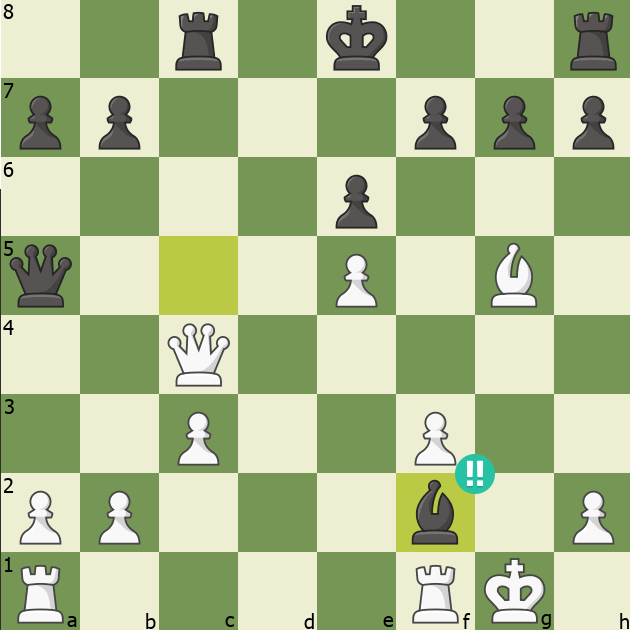
Brilliant Chess Move: Stunning Bishop Sacrifice Led to Checkmate
Most chess players have experienced it at least once. You spot a free pawn, win some material, and feel confident about your position—only to discover that your opponent had seen something much deeper.

Why Your Chess Accuracy Drops After Move 15
If your chess accuracy drops after move 15, the problem is not that you suddenly become a worse player. The problem is that the game has shifted from memory to understanding, and you have not trained that transition enough.
Why You Always Get in Time Trouble (And How Stockfish 18 Fixes It)
Every chess player knows the feeling. You navigate the opening perfectly. You transition into a solid middlegame. You build a completely fine, perhaps even slightly superior, position. And then, you glance at the clock. Your opponent has 15 minutes left. You have 42 seconds. Panic!